Saturday, September 24, 2011

Moose Time!

Maine Bull Moose Overlooking a pond
canon 1D MK IV; Canon 600 f4 @f4 1/2000 ISO 640

I traveled to the Maine North woods this past week to spend a few days looking for moose. Saturday evening found me along a good spot near Millinockett Maine watching to see if moose would enter the pond to feed before dark. I spotted one cow across the pond and got some distant shots.  I met up with a friend from Vermont later in Millinockett and we decided to walk to one of our favorite spots the next morning before we departed for out trip farther north.  We had clear skies and nice golden light and the very nice bull pictured above came through apparently on his scrape trail and we were able to get some photos in the golden light. The next image is an example of how one moment we can have beautiful light and a few moments later, we have shadows and highlights. The bull apparently had recently lost his eye in a fight. 

Canon 1D MK IV; 600 f4 @f6.3 1/200 ISO 1000

Later in the day we traveled with three other friends over log roads to a cabin at a remote lake in the North Maine Woods.  The setting was absolutely beautiful. Most of our moose looking was going to be done by kayak with some walking logging lanes mixed in.  The weather was beautiful with clear blue skies scattered with puffy white clouds.

Canon 7D; Canon 24-105 f4 @24mm f13 1/400 ISO 320

Paddling the stream and lake was a joy. Bitterns, ring neck ducks, pie billed grebes, white throated sparrows, yellow throated warblers, bald eagles, ospreys Northern harriers, broad wing hawks and Common Loons entertained us through the week.

Canon 7D; Canon 24-105 f4 @24mm f11 1/400 ISO400
The water was high due to the recent storms and that  most likely effected the moose activity along the water.  We did however hear bulls and cows grunting and wailing in the woods and we had moose tracks right past the cabin.  We did spot a few moose.  It was good practice for shooting from a kayak.
Canon 1D MK IV; Canon 300 f2.8 @f10 1/250 ISO400 -.33 EC

Canon 7D; Canon 24-105 f4 @58mm f10 1/320 ISO400 -.33EC

Since I had the longest distance to travel home (15 hours), I left early Thursday morning.  On the way down the log road I came upon a small bull in the mist.  I stopped, got out of jeep and photographed him for about an hour.  I practiced my bull grunts and cow wails with him and we had fun. 

Here are a few shots of him:
Canon 1D MK IV; Canon 300 f2.8 f2.8 @f2.8 1/125 ISO 2000

Canon 1D MK IV; Canon 300 f2.8 @f4 1/125 ISO2000

Canon 1D MK IV; Canon 24-105 f4 @105mm f4 1/50 ISO800

One of the benefits of shooting with the Canon 1D MK IV is that it allows us to push the ISO and still get great quality pictures.

Until next Time

Jim Borden


Monday, September 5, 2011

Wildlife Photography and Light!

Canon 1D MK IV; Canon 600 f4 @f4 1/1600 ISO3200

I have touched on the need for fast lenses and high ISO in my posts before-this time I am going to elaborate a little on the topic and share experiences with the noise performance of various bodies.  The above photos was taken on a very cloudy, rainy, dark day.  Turkeys are normally out in weather such as that and they are almost always on the move.  Their heads are continuously bobbing up and down.  So fast shutter speeds are needed to get crisp shots. In film camera days one would have to wait for a well lighted day and hide and call and wait for them to get close and then time the shots for a still shot.  Digital technology has helped us immensely with the ability to take shots in poorer light conditions. However, even though many camera bodies boast about ability to run ISO to 3200 or 6400, they have lots of digital noise which ruins color saturation and edge detail.  I have found that camera bodies with full frame sensors and less megapixels to out perform heavily cropped sensors with lots of megapixels.  For Instance, the Nikon D3s is probably without argument the best perfomring Camera body on teh market for lack of digital noise.  It has a full frame sensor with only 12 megapixels-but the pixels are large and thereby can be pushed to higher ISO rating without noise.  We hav etaken photos at ISO 6400 that have required no post processing for noise control. One of the worse performers in recent past is the Canon 7D with 18 megapixels on a 1.6 crop sensor.  It handles ISO up through 500 to 640 okay as long as the histogram is kept to the right.  Even then post processing is required.  Does this mean the Canon 7D is not a good body?  Absolutely not-It takes very good images at the lower ISO ratings and it can be used at ISO 640 or so with post processing.  here is an image my daughter Andrea took with my 7D and Canon 300 f2.8 lens at ISO 640.

Canon 7D; Canon 300 f2.8 @f5 1/200 ISO640
She timed the shot so that she did the capture as the bear raised its head and stopped to look. 

For comparison, here is an image of the same bear taken with the Canon 1D MK IV at 1600 ISO.   Looking closely at the green ferns in the background, one can see the noise performance difference of the two camera bodies.
Canon 1D MK IV; Canon 600 f4 @F7.1 1/500s ISO1600

Here is a shot with the Canon 1D MK IV at dark one evening this week.  It is also taken at ISO 3200 as the turkey shot was taken-however, the shutter speed was 1/25.  It is an ok image and as one can see, the sharpness and "pop" is less and that is most likely due to the very slow shutter speed on a large lens (600mm).  In my film days this would have been a blurry picture!!!  The image has good color and contrast, but detail is missing in the hair and eyes.

Canon 1D MK IV; Canon 600 f4 @f6.3 1/25 ISO3200

From my experience with camera bodies, here is a list of best to worse performing on noise:
Nikon D3s; Canon 1D MK IV; Nikon D700, Nikon D300/D300s;  Canon 7D/Nikon D80

Until next time

Jim Borden


Tuesday, August 30, 2011

Hills Creek State Park

View of Lake from Picnic Area next to Beach

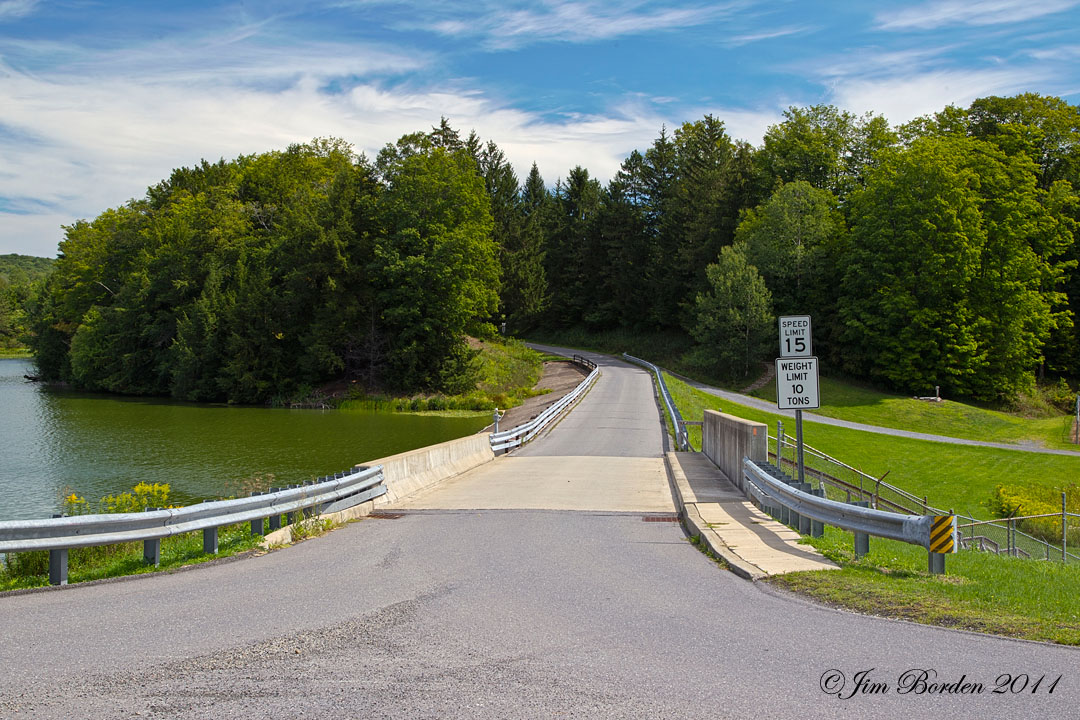
Hurricane Irene left us without power for the machine shop and the skies the day after the storm were beautiful so I decided to take a short trip to Hills Creek State Park and the Pa Grand Canyon.  Hills Creek park is very special place to me as my grandfather was one of the ones that pushed for the lake to be made and a park to be formed.  I fondly remember family picnics there when I was a youngster and it is where I was taught how to use a canoe. I wanted to take the opportunity to see if I could get an exposure with a single image as compared to what I could do with HDR.  The objective was to most closely match what I saw with my eyes.   The wind was blowing steadily and the skies were dark blue with white, puffy clouds.  I used the Canon 1D MK IV with Canon 24-105 f4 lens with a circular polarizer mounted for all shots. I found that once again the HDR compilatrions of three to five images delivered the most realistic looking images of the scenery.

View of lake from breast of dam

View from Fishing pier at lower boat access

The swamp behind the Cabins

Road across the dam.

The view at Harrison Lookout at the Canyon was great with the puffy clouds-but the lighting was harsh. A graduated density filter would have come in handy to take good images there. 

Until next time

Jim Borden

Sunday, August 14, 2011

Maine Lighthouses and Coast

Nubble Lighthouse at Cape Neddick


A friend and I traveled to Maine last week to compete in a National Rifle Match in Augusta.  We left three days early to spend some time along the coast viewing and photographing lighthouses and coastal birds.  My planning was not perfect as we hit Lobster Festival weekend and the coastal highways were packed with traffic.  As a result we did not get to see as many lighthouses as desired-but still had a great time.  I love the rugged Maine Coast.  Once again, I applied the use of HDR to some images to produce an image that was what I saw with my own eyes. I had intended to pass by Nubble lighthouse as I have taken so many images of it, but the skies were full of puffy and stormy clouds and I had to stop and see what different effects I could see.  Ended up capturing a partial rainbow with the lighthouse and stormy skies.


Portland headlight is close to being my favorite lighthouse along with Nubble. We also were able to observe it with stormy skies.  There were more people there this time than any time I had previously visited it. So I stayed away from doing any closeups as I did not want people to become a focal point in the images.


This was my first visit to owl's Head light and the scenery from there is absolutely gorgeous.

This was also my first visit to Marshall Point and we enjoyed a good share of the day there as traffic on US1 was bumper to bumper and the coast and crashing waves offered peace and relaxation.

The following gulls were taken in harsh lighting with a better beamer to tame the shadows and harsh light.


Until next time


Jim Borden

Thursday, July 28, 2011

Adirondacks


We traveled to Speculator NY last weekend to look for moose in the Adirondacks.  It has been years since we stayed in the Adirondacks and it was a pleasure to return.  We traveled many log roads and accessed some remote areas and saw lots of pretty scenery.  We saw a black bear, lots of black bear tracks, a few deer and lots of coyote tracks.  Mornings were calm and afternoons were extremely windy.  We experimented with HDR and panoramas.  The shot below is of Mason Lake just above Speculator New York and it is a HDR panorama.  It is made up of three shots are metered exposure, 3 at -1 stop and three at plus 1 stop.  The 9 shots were combined in photoshop to attempt to produce what we saw in person.
Cano 1D MK IV Canon 24-105 f4 @ 24mm f16 ISO200

Joan took the deer shot in the dark woods with her D3s set at 1600 ISO.  Notice the fine detail of the deer and no noticeable noise!!!

Nikon D3s; Nikon 80-400 @400mm f8 1/160 ISO 1600
The following is another HDR shot taken with the Canon 1D MK IV.  It is a set of three images so that the image actually shows what the human eye saw for light range.  I find that many folks push their HDR composites to unrealistic looks.  I prefer to use the technology to replicate what I actually observed. 

Joan loves clouds and silhouetted trees!  She captured the following first thing in the morning. 

There were Black eyed Susans decorating the roadsides, the medians and even in log truck landing areas in the forest.  The following shot was taken with a Canon 24-105 f4 lens with the Canon Macro filter screwed onto the lens to convert it into a macro lens.


Until next time


Jim Borden


Wednesday, July 20, 2011

Herons, egrets and other Wildlife at Walkill NWR

Nikon D3s; 80-400 Nikon at 400mm f8 1/500 ISO250 (Joan Borden)

We traveled to Liberty Loop Trail at the North end of the Walkill NWR. The trail is part of the Appalachian Trail and a portion of the loop is in New York State and a portion is in New Jersey.  It is in the "Black Dirt" region of New York State.  We enjoy going there in the winter for Hawks and Bald Eagles and in the spring for the duck migration.  We decided to visit it during the summer to see what we could see.  We got there later than we wanted to and the lighting was very harsh for photography.  We saw about a dozen Great Blue Herons, two Great Egrets, 1 Green Heron, various warblers and various insects.  It was an enjoyable day.  The Green heron was very skittish and avoided being photographed three times.  Joan does not like the weight of big prime lenses and she has found the 80-400 Nikon lens is working well with the D3s body.  We spent time calibrating the focus system during the week and it paid off.


Great Blue Heron with Great Egret in background
 1D MK IV; Canon 600 f4 @f9 1/640 ISO 400 (Jim Borden)

We enjoyed watching the Blue Herons and Egrets argue over "turf". The blue herons would share spots and fish-but became agitated when one of the egrets would get near.  Lots of wing flapping and cackling would result until either the egret moved or the Great Blue Heron gave up the space.


Great Blue Heron Strutting
Canon 1D MK IV; Canon 600 f4 @f9 1/640 ISO 400 (Jim Borden)

The wet areas of the trail had lots of dragonfly and skimmer activity.  Another set of subjects to photograph and then research to learn about them.  That is one thing we are immensely enjoying about the immersion into photography is that it is a way to stop and "smell the roses".

Dragonfly
Nikon D3s; 80-400 Nikon at 400mm f8 1/125 ISO320 (Joan Borden)

Common Whitetail
Canon 1D MK IV; Canon 600 f4 @f9 1/640 ISO 400 (Jim Borden)


Until Next Time

Jim and Joan Borden


Friday, July 15, 2011

Nicholson Bridge

Mid-day July 3, 2011, Canon 1D MK IV; Canon 24-105 f4 @24mm f16, 1/100 ISO 200

The Nicholson Bridge (aka Tunkhannock viaduct) is a concrete railroad bridge that crosses Tunkhannock Creek in the little village of Nicholson Pa.  When it was finished in November of 1915, it was the largest concrete bridge in the world. It retained that distinction for 50 years. The bridge is 2375 feet long and 240 feet tall.  It is a grand thing to see. I have tried to photograph it in early morning light with mist rising around it as well as mid day with puffy clouds in the background.  I am anxiously waiting to be able to catch it with clouds and a pink/red sunset on it.

Sunrise September 6, 2010; Canon 1D MK IV; Canon 24-105 f4 @24mm f14, 1/160 ISO 200 EC-1

Hopefully next week, I will return to a posting about Wildlife!

Jim Borden