Sunday, May 22, 2011

Fawn and Birds

The windy, rainy, cloudy weather has presented some challenges for wildlife photography this spring.  Doing wildlife requires having high enough shutter speeds to capture the subjects without blur.  Overcast and rainy conditions reduce light.  So most of the work is done at elevated ISO speeds which impacts on image crispness.  It has been fun watching ducks in two of my friends ponds.  One pond has Mallards with young, Hooded Mergansers with young and wood ducks with young.  I have captured shots of all of them-but only a few of the shots are satisfactory for publication.

Here is best shot of the Hooded Merganser female with a part of her brood:
Canon MK 1D; Canon 600 f4 with 1.4TC @f10 1/320 ISO 1000

While I was sitting in blind waiting for the ducks a male and female Red Wing Black Bird kept scolding me.
Canon MK 1D; Canon 600 f4 with 1.4TC @f10 1/160 ISO 640

On my way to one of the duck ponds I cam upon this fairly new born fawn.
Canon MK 1D; Canon 600 f4 with 1.4TC @f8 1/160 ISO 1000 EC+.33

Yesterday while out and about I saw a dark spot in the grass and found this little guy hiding!
Canon MK 1D; Canon 600 f4 with 1.4TC @f9 1/250 ISO 640


Until Next Time

Jim Borden

Sunday, May 15, 2011

More Spring Birds

I have not had time to be out and about taking photos as much as I would like in past three weeks. I have escaped for a few moments to capture some of the spring migration.

Baltimore Oriole snuck up on me as I was watching an Eagle nest.
Canon MK IV 1D; Canon 600 f4 with 1.4 TC; @f9 1/400 ISO 800

Northern Tufted Titmouse
Canon MK IV 1D; Canon 600 f4 with 1.4 TC; @f9 1/400 ISO 800

One of my favorite waterfowl: Wood Duck Drake
Canon 7D; Canon 600 f4 with 1.4 TC; @f10 1/200 ISO 500 EC+.67


Until next time

Jim Borden

Saturday, April 30, 2011

Adventures with Fox Kits

Had planned on going to Hills Creek Lake today to get sunrise photos for the Park Office--but it was very overcast and stormy so decided not to drive the two hours.  Later morning cleared and I went to some of my local haunts!  The warblers are moving in.  Saw thirty three different species of birds today-not a great count-but encouraging after a long winter.  A friend gave me a tip on where I might see some fox pups .  I "camped out" behind a log for a few hours and it paid off.  One of the little guys came out to play.  I got some ok shots of him but nothing I was real pleased with.  After going home to pick up Joan-we returned and before we got to the spot we saw the adult fox and could not get any pictures.  We went on and set up behind some brush.  Soon a Raccoon came ambling through and we were able to photograph him.  He decided to snoop around and crawled into the fox den-Well, he came out a lot faster than he went in. 


Canon MK IV 1D; Canon 600 f4 with 1.4TC; @f8 1/200 ISO800


Soon a fox pup emerged from the exit hole and we got some good pictures in nice light-but a little back lit.  Soon we saw more motion and it was a second pup out running and playing.  


Canon MK IV 1D; Canon 600 f4 with 1.4TC; @f10 1/160 ISO800 EC+.67

Canon MK IV 1D; Canon 600 f4 with 1.4TC; @f8 1/400 ISO800


While watching them, I saw a bird coming at us fast and it was a Cooper's hawk and it landed in tree on a branch above my shoulder-he was too close to take a picture (minimum focus distance on the big lens is 18 feet).  We were also treated to Yellow bellied sapsucker, chestnut sided warbler, pileated woodpecker, red bellied woodpecker, downy woodpecker and cackling eagles.  


Canon MK IV 1D; Canon 600 f4 with 1.4TC; @f9 1/1000 ISO500

Canon MK IV 1D; Canon 600 f4 with 1.4TC; @f7.1 1/1000 ISO400

Canon MK IV 1D; Canon 600 f4 with 1.4TC; @f9 1/125 ISO500


The eagle nest that had been near there was blown down in recent storm.  Other hikers were along the river and apparently the eagles were along the river as well.

Enjoy!

Until Next Time

Jim Borden

Monday, April 11, 2011

Owls and Eagles

Great weekend.  Visited one of the eagle nests that we keep track of and two eaglets have hatched.  the nest is over two yards from road and in interest of not disturbing the eagles, I set up and take photos from the edge of the highway.  Because of the clutter of branches around the next I use live view with the screen magnified 10x and use manual focus and a cable release.  The photos are primarily used as documentation as they are severely cropped.  Look closely and you can see the two little eaglet heads watching the adult shred a fish for them.


After watching the eagles, I went to the top of the mountain to a dense area of evergreens where I can usually find barred owls this time of year.  Sure enough they were there and I captured better photos of them this year than last year due to the time I had taken to finely calibrate the af tuning on my camera bodies and lenses.


Spring must be coming!!!! The brown creepers are back!

Until next time!


Jim Borden


Sunday, April 3, 2011

Another Weekend of Birding-another Eagle Nest

Had planned on working all weekend as the weatherman had called for clouds and cold and general bad weather for the weekend.  However, Saturday morning started out with blue skies with scattered light, white clouds-so I decided to go look for ducks.  I first stopped at a small lake about 5 miles from our house and was watching buffleheads, hooded mergansers and common mergansers when a large soaring bird caught my eye.  Sure enough it was a mature Bald Eagle. It landed in a tree at upper end of the lake.  the residents see them here often and I have seen them in that area but have not located their nest yet.  I have also seen a pair of adults near Tunhannock flying up and down the river and it seemed that they were there quite often and that it did not seem logical that they would be using the three nests I knew about along the Susquehanna.

Bufflehead male and female
Canon 1D Mk IV; Canon 600 f4 @f9 1/1600 ISO500 

Common Merganser Male
Canon 1D Mk IV; Canon 600 f4 @f9 1/1250 ISO500

Mature Bald Eagle
Canon 1D Mk IV; canon 600 f4 @f9 1/1600 ISO500

I then decided to drive to a remote pond on an old farm that is in a wooded area to check for ducks. Upon arriving I saw two adult bald eagles in the air carrying nesting materials (odd for this time of year) and they were headed back to the Susquehanna River. I met the landowners and we made friends and they consented to me entering the property to photograph wildlife.  We had "known" each other for years but had never really formally met.  It turns out we have have common interests in wildlife and birds.  While the lady and I were talking an immature Bald Eagle flew over.  I found the pond had Canada Geese, Common Mergansers, Hooded Mergansers, Ring Neck Ducks and mallards on it along with a Great Blue Heron.  The owners were there with a surveyor and the ducks were at the far edge of the pond and approaching them from the other side put the sun in my face.  I decided to look for the Eagle nest that I knew must exist along the Susquehanna.  I stopped along a road that overlooks part of the river and began scanning the tree line on each side as well as trees on the islands.  I had about given up when a White spot about one half way up a sycamore tree caught my eye.  Observation with the spotting scope revealed it was a nest and had an adult eagle settled into it.  I found a place to park and walked the bank above the river to find a place I could see through the trees.  I finally found a spot about 175 yards from the nest and I set up with the 600mm lens with a 1.4 TC mounted.  Brush between me and the Eagle head interfered with focusing automatically so i used live view at 10X magnification and manually focused and used the remote release.
Canon 1D Mk IV; Canon 600mm f4 with 1.4TC; f9 1/1000 ISO 640 manual focus

Had to run some errands in town and then just before dark I decided to check on the ducks at the remote pond.  On the way there I saw a pair of hoodies on the farmer's pond nearer the house and they were in good light.
Canon 1D Mk IV; canon 600 f4 @f9 1/640 ISO500

On the way home i saw two large flocks of Turkeys and the one flock had a mature gobbler strutting and fanning.

Canon 1D Mk IV; canon 600 f4 @f10 1/800 ISO1000

This morning I went to the remote pond prepared to get lots of duck shots.  I had my cam clothing, my Ghillie suit, my blind and my stool.  When I arrived the ducks were close to the entry road and they quickly scooted to the far side of the pond.  I decided to hike back to where I had planned to set up and I did so carefully.  When I got to the small cove I found it loaded with common and hooded mergansers.  I was careful and setup and was waiting to get some good shots when all of a sudden two ducks that had been in the brush along the edge not 5 yards from me decided I was a threat and they exploded out of there and all of the ducks went to far side of pond (which really could be called a lake).  I went to the other side and set up again and waited and the Ring Neck ducks would only come so close to the blind-but i enjoyed every minute of it.
Canon 1D Mk IV; canon 600 f4 with 1.4 TC @f7.1 1/1250 ISO500

Went home to meet Joan and we went north to another friend's place that is remote in woods and there are some good ponds there.  It is only 18 miles north of us and we found most of the ponds still frozen, ice on the back roads and snow!!!  We found one beaver pond only half frozen over and there were 4 female and 4 male wood ducks there.  We watched them for over an hour.  Then some turkeys came and spooked them. I already have quote a few wood duck pictures-but none that I ever considered "killers".  Well, today I took a number of shots that are better than any I have ever taken of wood ducks.

Canon 1D Mk IV; canon 600 f4 with 1.4TC @f10 1/400 ISO500
Canon 7D; canon 600 f4 with 1.4TC @f10 1/320 ISO500 EC+.67


Canon 7D; canon 600 f4 with 1.4TC @f9 1/100 ISO500 

Until next Time

Jim Borden


Sunday, March 27, 2011

Spring-A Time of Transition

Spring brings new life to the woods and it is also a time of life cycle changes in the wild animals.  Many antlered animals(particularly those that are truly wild) loose their antlers shortly after the RUT is over.  Moose in the north country loose theirs by early to mid December to help conserve precious energy during times of heavy snows.  In contrast to that, the Pennsylvania Elk loose theirs in late March.  This year was in fact earlier than it has been in the past three years.  We made our end of winter-beginning of spring weekend trip to Pa Elk Country the weekend of 3/18-3/20.  We stayed in the Elk Hideaway on Winslow Hill (a beautiful place to stay).  We were treated to six young bulls in the lawn on Sunday morning.  Our tours and walks in the area rewarded us with sightings of over 200 elk (not bad considering the entire herd is estimated to be 750 to 800 animals by the Pa Game Commission).   We had friends with us that had never seen pa Elk before and they had a great time.  They were also amazed at how close we could get to them without "spooking" them.  Our gentleman friend is a hunter and he kept remarking that he could not believe that some actually "hunted" these elk.  We did not see the extremely large bulls that were are accustomed to seeing in winter at all this winter.

Prior to departing for the trip I was waiting for Joan to get her things packed and our little pond had its annual male and female mallard Ducks visiting.  I had been frustrated with the percentage of good focused shots I had been getting over the past year and this winter I had calibrated my lenses and camera bodies using the Lensalign system.  After using that I had found that close shots were phenomenal and longer shots were significantly out of focus.  So, after studying the Lensalign unit and techniques for using it, I found that I had not calibrated at the correct distance for each lens.  I re calibrated the 600mm lens at 98 feet (50 times focal length) and the 600mm with 1.4 TC at about 135 feet and was anxious to try it.  The male Mallard posed for a few shots first and I am pleased with the focus result-the are of target is centered in the depth of field.

Canon 1D Mark IV; Canon 600mm f4 with 1.4TC; f8 1/160 ISO500 about 62 yards

The female then decided she wanted to picture taken.
Canon 1D Mark IV; Canon 600mm f4 with 1.4TC; f9 1/400 ISO1000 about 62 yards
With those shots under my belt, I was ready for elk at any distance as I had already calibrated the 300 f2.8 at 48 feet on both the mark Iv and 7D bodies. On Friday afternoon we saw 60 plus elk on the left edge of the mine reclaim area at end of Dewey road so the four of us took a walk to see if we could find the remainder of that herd and to see if any of the big bulls were hanging with the cows and calves.  we found a rag-horn bull and some spikes hanging out with the cows.  they were munching on the green sprouts in the reclaim area and easily allowed us to walk among them.

We had strong sunlight and had to maneuver so that we could get them at least side lighted instead of back lighted.  I used exposure compensation on the first picture to lighten the exposure of the elk bodies against the back lit scene.

Canon 1D Mark IV; Canon 600mm f4 with 1.4TC; f9 1/250 ISO500 EC +.67 over 100 yards 
Canon 1D Mark IV; Canon 600mm f4 with 1.4TC; f9 1/800 ISO500 over 100 yards

We took a ride up Gray Hill and saw bulls in the evening darkness and saw one dominant bull that had dropped his antlers-but we could tell he was the dominate bull as he was chasing the young bulls away from the food and they were respecting him.  

On Saturday morning we returned to the end of Dewey Road and found the second part of the large herd had joined with the elk we had seen the night before-now there were over 100 elk in that group.  We found a lone bull with antlers standing in the woods.  He had separated from the bachelor group of six bulls that we had seen earlier.  he stayed in one spot all day and was acting lethargic.  Friends living in the area said that the bulls seem to do that when they are ready to drop their antlers.  The sun was streaming through the bare trees which makes talking a picture difficult.  I normally use a better beamer in a situation such as this, but i had left it in the jeep.  The picture shows a bull in his natural habitat--not an image that would be a wall hanger-but an image that demonstrates where and how the elk live. 

Canon 7D; Canon 70-200mm f4 at 150mm; f9 1/400 ISO640 about 13 yards

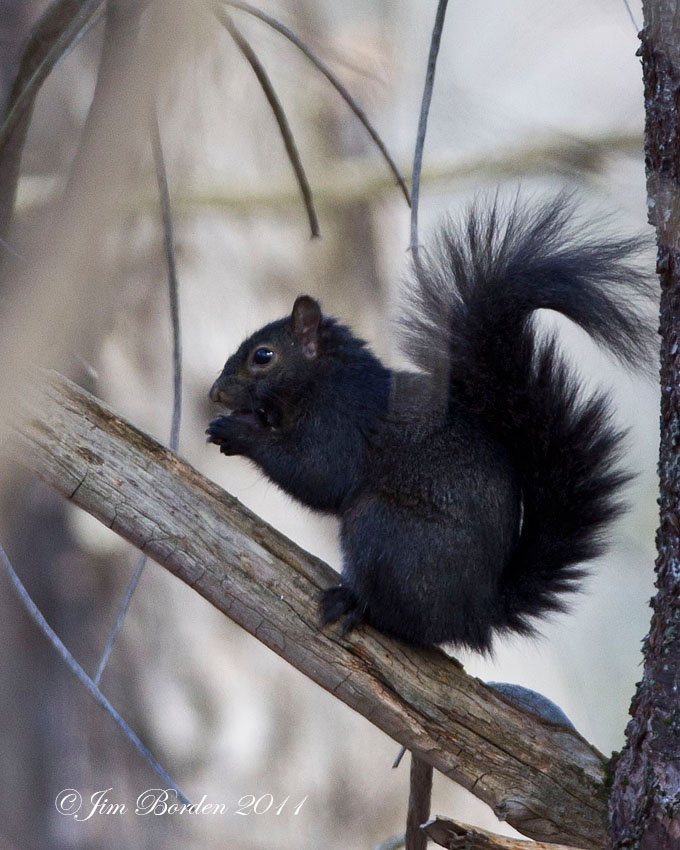
We have always found black squirrels on this part of Gray Hill and we were treated to 4 of them on this afternoon. 

Canon 1D Mark IV; Canon 600mm f4; f4.5 1/250 ISO500 about 44 yards

A favorite spot of mine where I can usually find a large group of bachelor bulls only had one bull there and he had dropped his antlers already.  He posed for us in many positions in what i considered good, contrasty light.
Canon 1D Mark IV; Canon 600mm f4; f5.6 1/160 ISO500 about 60 yards

The elk were out feeding throughout the day and we found a group of 4 bulls behind one cabin having their afternoon snack.  Two of the bulls are developing decent racks and may be trophy bulls in the future. This picture was a good candidate for me to use the better beamer with--sure would next time to help eliminate the shadows.

Canon 7D; Canon 300mm f2.8; f6.3 1/200 ISO640 about 50 yards 
Canon 7D; Canon 300mm f2.8; f6.3 1/160 ISO640 about 50 yards
Canon 7D; Canon 300mm f2.8; f6.3 1/250 ISO640 about 50 yards

I have hated the tracking collars that some of the elk are wearing (put on by Pa Game Commission).  they are huge, ugly and the yellow marker with numbers can be seen from long distance.  I am glad to see that the collar size has decreased and it is now dark brown and sport the new smaller satellite transmitters and antenna.  the number has been eliminated-YEAH!!!!  This bull with dropped antlers took a few moments to pose with the new style collar for us.


We concluded our day of touring on Saturday by visiting the upper parking area along Dewey Road.
Canon 1D Mark IV; Canon 24-105 f4; f13 1/80 ISO400

At day break Sunday morning we had six bulls in the lawn of the Elk Hideaway.  They ate leisurely and sparred before heading off to other areas. Note the shutter speed on this picture-that bull had to lay perfectly still to get this shot with no blur.

Canon 7D; Canon 300mm f2.8; f6.3 1/2.5 ISO1000


The bull later decided that Ginny's bushes looked ready to eat and he meandered over to the bush while the rest of the bulls were sparring. 
Canon 1D Mark IV; Canon 300 f2.8; f4 1/200 ISO 1250 about 50 yards


Until next Time

Jim Borden


Friday, March 11, 2011

Migration

The weekend of March 4 was forecast to be dreary, cold and wet in our area and Joan suggested she take me somewhere for my 60th birthday.   I looked at the weather in southern Pa and decided that it was time to visit the Middle Creek Wildlife management area.  We arrived there early Friday morning and were immediately treated to "lots" of Tundra Swans and 1000's of Snow Geese.  Later in the day we learned that the Pa Game Commission estimated 60,000 plus Snow Geese and over 8000 Tundra Swans.  The lake was covered with the Geese-it was truly moving to see such a wonder.  It was awesome when two immature Bald Eagles flew along the top of the water which spooked the Geese.  We also got to see Gadwall ducks, Ring Neck Ducks, Black Ducks, American Wigeon, Mallards, Hooded Mergansers, Buffleheads, Kill Deer, Northern harriers, Red tail hawks and Kestrels.  I had a great time practicing taking flying shots.  the geese and swans gave me plenty of opportunities to hone my skills.  Joan also had a ball getting used to her 80-400 lens with flying shots.

Swans in formation.   Did not quite capture lighting correctly on this one.

Canon MK 1D; canon 600mm f4 @f8 1/2500 ISO 500 

Tundra Swan against Blue Sky
Canon MK 1D; canon 600mm f4 w 1.4TC @f7.1 1/2000 ISO 640 EC +.33

Snow Goose coming in for Landing
Canon MK 1D; Canon 600mm f4 @f8 1/1250 ISO 500 EC+1

Joan got this Snow Goose coming in for landing on a small pond.
Nikon D300; Nikon 80-400 @400mm f8 1/1000 ISO 500


Nikon D300; Nikon 80-400 @116mm f8 1/1600 ISO 500


Two Snow Geese and a Blue Phase flying in

Canon MK IV 1D; Canon 600mm f4 w/1.4TC @f9 1/1000 ISO500 EC+1

Ring Neck Duck
Canon MK IV 1D; Canon 600mm f4 w/1.4TC @f9 1/640 ISO400 EC+0

American Wigeon Male
Canon MK IV 1D; Canon 600mm f4 w/1.4TC @f8 1/500 ISO400 EC+.67

I captured this one at same time as Joan did.  I was very lucky that the goose was almost at the end of the landing and was almost stopped in the air-my shutter speed was low for a flying bird-but lucked out!
Canon MK IV 1D; Canon 600mm f4 w/1.4TC @f8 1/500 ISO500 EC+1

The following shot illustrates the technique of diagonals in composition--it is one of the basics that draws viewers to photos along with rule of thirds.
Nikon D300; Nikon 80-400 @400mm f8 1/1600 ISO500

Action shots are always interesting.  having the camera set so that shutter speed is fast enough to stop action is important.  the following image illustrates how the shutter speed of 1/1250 stops even the water droplet action-the drops seem to float in the air.

Nikon D300; Nikon 80-400 @400mm f7.1 1/1250 ISO500


Until Next Time

Jim & Joan Borden