Tuesday, March 27, 2012

Barred Owl


I have been photographing a pair of owls for the  three previous years.  They return to the same spot each March and they are very cooperative.  The spot is in heavy evergreen forest area and it is quite dark in there but sun light streams through the trees.  It makes for complex lighting that is hard to photograph.  This year only one of the owls has returned thus far, but I am hoping the other arrives in near future.  I had previously deferred using a flash of any sort on the owls as I was afraid their eyes were sensitive and flash would scare them and maybe effect their eyesight.  Research on that over the past year showed that is a misguided conclusion.  A very good article written on it by Dr Dennis Olivero describes that is quite ok.  Click here for a link to the article. 

So-this time I tried some photographs with and without the better beamer for fill flash.  The better beamer images are evenly lit with no evidence of flash being used.  The shadows are gone and the fine detail of feathers is present. The exposure was set manually with flash turned off an then fill flash with values from -1/3 to +2 were used to get just right blend.

Until next time.

Jim Borden

Click here for more camera critters.

Wednesday, March 14, 2012

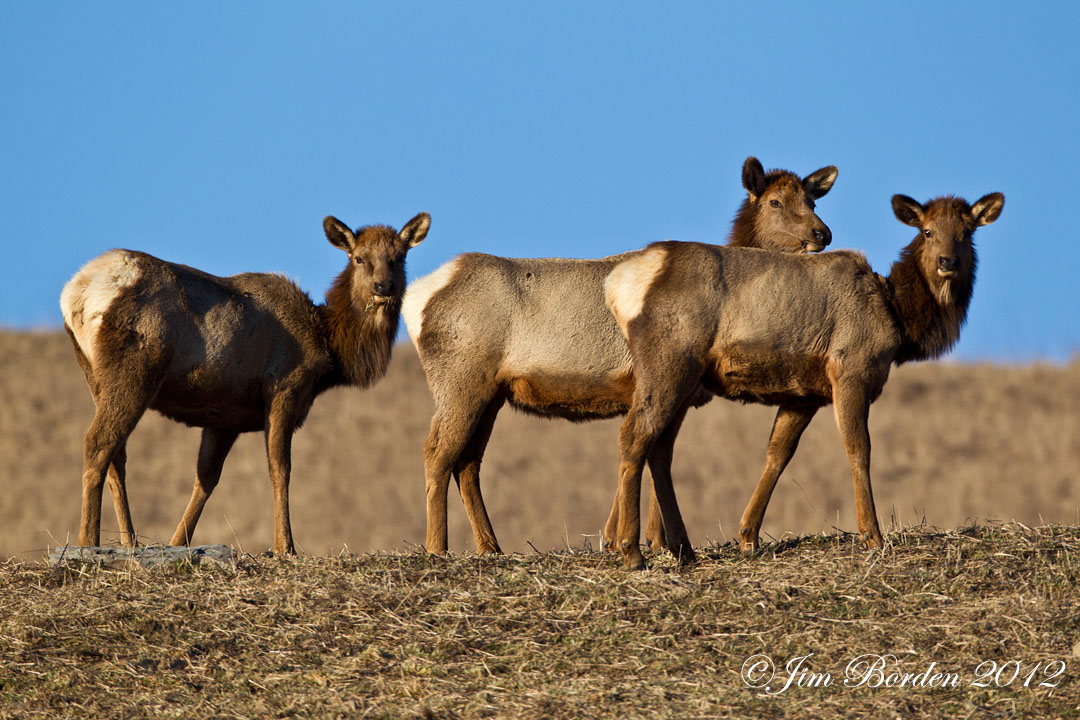
Pa Elk in the Late Winter


We had a great time in the Benezett Pa area over the last weekend.  We saw lots of elk but only a handful of mature bulls.  It has been extremely warm and the bulls are preparing to drop their antlers and are laying in wooded areas where it is cooler.  We saw the Dewey Road herd that numbers well over 100 cows, calves and spike bulls. On Saturday evening I was able to find 3 5x5 rag horns and an old friend from last fall-a 7x7 with a broken tine on his left antler.  He was very skittish and did not seem to like having us around in contrast to me being able to follow him around for three days last fall.  Skittish or not I was able to stay within 100 yards of him for long enough to get a good series of shots of his attitude.  The above shot was taken as he approached us from out of the woods.  The next shots show how he showed his displeasure for us being there.


The following shots are of some of the elk at the end of Dewey Road.


Until next time!

Jim Borden


Thursday, March 8, 2012

Camera and Lens Focus Calibration


I have previously mentioned the importance of calibrating lenses and camera bodies for focus performance.  Cameras and lenses made by the major manufacturers like Canon and Nikon are very closely controlled for tolerances.  Yet, tolerances still exist that mandate checking and calibrating to make sure the auto focus system is actually focusing on the focal plane of the sensor. Usually lens and camera bodies are either front or rear focused.  A standard practice the past few years has been to use inclined plane tools that have a focus target and an inclined ruler running front to rear.  The camera is focused on the target, a shot is taken and then the ruler is analyzed to see how the depth of field centers on the focal plane. If it does not (which is usually the case), the camera body is then adjusted through MA on a Canon or AF Fine tune on Nikon.  The MA or AF setting is adjusted in increments and more shots are taken until the DOF centers on the focal plane of the target. The method takes time and is somewhat subjective.  

Recently my good shooting (Competitive rifle and camera) friend Bob Adamowicz introduced me to FoCal software from Reiken (http://www.fo-cal.co.uk) in the UK.  It is a software developed by Rich Meston of Reiken.  The program can be purchased and installed on your computer (right now only PC's) and then the camera is hooked to the PC, a target provided by Reiken is hung and properly lighted and you let the program do the work.  It runs the camera through MA (AF) settings from -20 to +20 and takes multiple shots at each setting to determine repeatability.  Then it predicts the best MA (AF) fit for that camera body/lens combination.  In addition it evaluates the relative value of the sharpness of the image. The pro version of the software provides a detailed pdf report along with a graph of all the points shot for the test.  The one shown at the top of this blog entry was my MK IV with Canon 600 f4 attached.  The quality of focus averaged about 2300 and the repeatability of quality focus was excellent throughout the curve.  The predicted MA (-5) agreed with the MA I had arrived at using the inclined rule method and the shoot tree bark at close range method :).  The key is it did it in about 3 minutes versus hours and it gave me a quantitative feel of the repeatability of the lens.  

I then tested the same lens with my 1.4 TC on it and it showed very good repeatability.  The IQ number can only be compared at same Target, aiming point, lens focal length and camera crop factor at current time. Rich is working on an algorithm so that a lens without TC can be compared to a lens with TC for relative quality of focus. 

It proved exceptionally helpful today while helping a fellow bird shooter.  He had been struggling with his 7D and 500 f4 particularly with TC mounted.  He was shooting from a Gitzo Tripod with ballhead and Wimberley Sidekick.  The test failed to perform completely twice with the 7D and 500 and when it did complete, it indicated that the prediction of MA was good, but the variability of shot to shot accuracy was high.  We then put the 7D and 500 on a Gitzo Tripod with Wimberley II Gimbal head. The test completed rapidly and yielded the same MA -but the variability of shot to shot accuracy was extremely low. 

Here is a graph of the 7D 500 f4 with Sidekick

Here is graph of 7D 500 f4 with Wimberley II

Bob Adamowicz and I have been using a long lens support system to reduce the vibration of long lens.  Initial testing that I have done with the Canon 600 shows that there is a positive shift in image quality using the support system.  We will be reporting on the Jim-Bob support system with pictures and sales details in the near future. 

I will also be shooting more tests with different supports and weighted versus non-weighted to determine a quantitative look at some of the commonly held beliefs on how to use long lenses.

Until Next time

Jim Borden


Wednesday, February 15, 2012

More Eagles and New Technique

Canon 1D MK IV; Canon 300 f2.8, f4 1/2500 ISO 640

We spent the weekend along the Delaware River with friends Chris White and Lee Cordner from Vermont and Bob and Rosamaria Adamowicz from Massachusetts.  We met an individual that is a very good Eagle Photographer.  I have followed his work on eagle photo sites for quite some time and was glad I could finally meet him in person.  It was a pleasure meeting him and he helped with added techniques for our eagle photography.  I have struggled with exposure on eagles to get a good balance between the dark feathers and the white head.  He suggested the use of our flash units with the better beamer installed.  I had used on small birds for quite a while but had hesitated on eagles due to fear of blowing out the whites.  He taught how to use effectively. 

We had the good fortune of experiencing fishing sequences five times so we could get some good practice in.  All shots were with manual exposure setting.


Canon 1D MK IV; Canon 300 f2.8, f4 1/2500 ISO 640, fill flash +1 ec
Canon 1D MK IV; Canon 300 f2.8, f4 1/2500 ISO 640, fill flash +1ec


Until next time

Jim Borden


Monday, February 6, 2012


Joan and I spent Friday February 3 along the Delaware River and lower New York State looking for Eagles. Normally this time of year is prime to see 50 to 75 eagles a day in that area.  However the warm weather this year has resulted in eagles not migrating and congregating in normal spots.  The rivers, lakes and ponds north of us have been open and eagles still have plenty of food source.  We did see 5 different eagles on Friday-all eagles that are nesting along the Delaware River.  We were teated to quite a show at the end of the day at Zane Gray Boat Launch.  Both of the resident eagles did a fishing pass for us three different times. 


Until next Time

Jim Borden


Thursday, February 2, 2012

Joan's squirrel


Winter time blahs tend to get us out and about to see what we can find. Joan has been practicing her long lens Techniques and it seems she has it pretty well nailed!  This young squirrel posed for her for a while.

Until next Time

Jim Borden

Sunday, January 22, 2012

Short Ear Owls and Harriers

Northern Harrier-Female

Each year in January the Short Ear Owls, Northern Harriers and Rough Leg Hawks show up at a farm near us to feed for a couple of weeks.  During mid day it is fun to watch the Rough Leg Hawks and Harriers cruise the fields for food.  Then, about an hour before dark, the Short Ear Owls make their appearance and chase the Hawks and Harriers from the fields.  The owls dart and dive and catch mice and perch on fenceposts, telephone poles and roofs of houses and barns.  I always look forward to visiting there this time of year to observe and capture the action. I have worked hard to get a good image of a harrier in flight.  Yesterday, was a great day!  The owls chased one of the harriers right over my head and I was able to get a good image of the female. 

The owls are somewhat elusive-but I was able to get more shots of them last evening sitting and in flight.  Most of the shots were high ISO so the detail is not as good as I would like.

Short Ear Owl sitting on Telephone pole.  Taken off bean bag laying over car window.

Short Ear Owl in flight taken from Wimberley II mount.


Until Next Time.

Jim Borden