Tuesday, August 30, 2011

Hills Creek State Park

View of Lake from Picnic Area next to Beach

Hurricane Irene left us without power for the machine shop and the skies the day after the storm were beautiful so I decided to take a short trip to Hills Creek State Park and the Pa Grand Canyon.  Hills Creek park is very special place to me as my grandfather was one of the ones that pushed for the lake to be made and a park to be formed.  I fondly remember family picnics there when I was a youngster and it is where I was taught how to use a canoe. I wanted to take the opportunity to see if I could get an exposure with a single image as compared to what I could do with HDR.  The objective was to most closely match what I saw with my eyes.   The wind was blowing steadily and the skies were dark blue with white, puffy clouds.  I used the Canon 1D MK IV with Canon 24-105 f4 lens with a circular polarizer mounted for all shots. I found that once again the HDR compilatrions of three to five images delivered the most realistic looking images of the scenery.

View of lake from breast of dam

View from Fishing pier at lower boat access

The swamp behind the Cabins
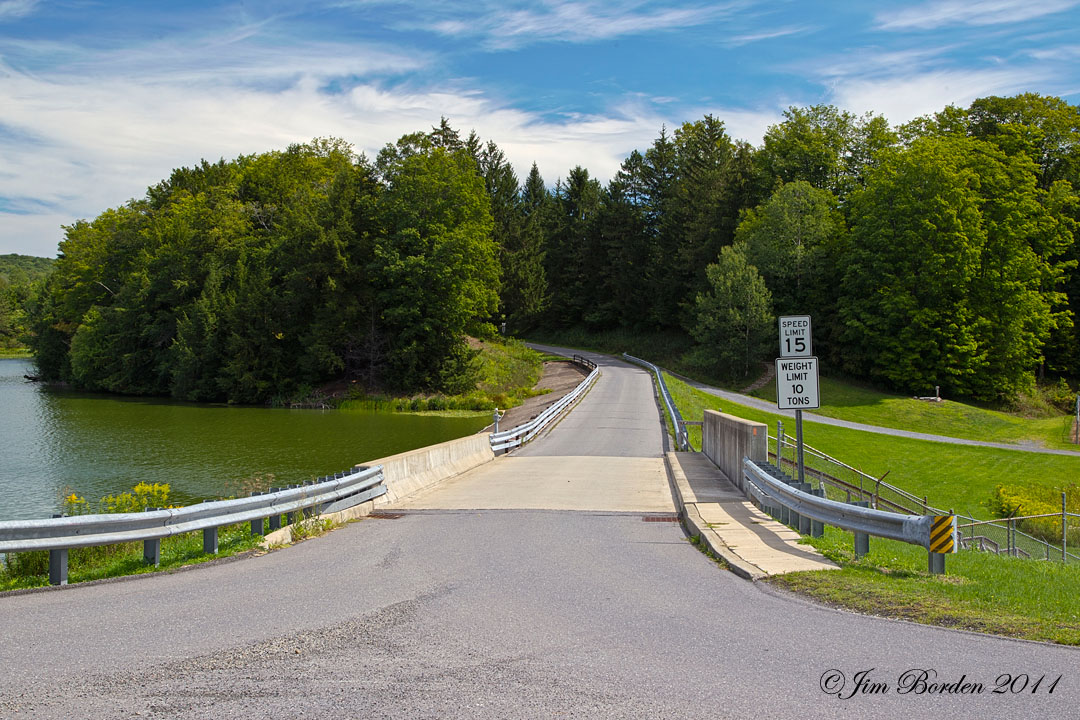
Road across the dam.

The view at Harrison Lookout at the Canyon was great with the puffy clouds-but the lighting was harsh. A graduated density filter would have come in handy to take good images there. 

Until next time

Jim Borden

Sunday, August 14, 2011

Maine Lighthouses and Coast

Nubble Lighthouse at Cape Neddick


A friend and I traveled to Maine last week to compete in a National Rifle Match in Augusta.  We left three days early to spend some time along the coast viewing and photographing lighthouses and coastal birds.  My planning was not perfect as we hit Lobster Festival weekend and the coastal highways were packed with traffic.  As a result we did not get to see as many lighthouses as desired-but still had a great time.  I love the rugged Maine Coast.  Once again, I applied the use of HDR to some images to produce an image that was what I saw with my own eyes. I had intended to pass by Nubble lighthouse as I have taken so many images of it, but the skies were full of puffy and stormy clouds and I had to stop and see what different effects I could see.  Ended up capturing a partial rainbow with the lighthouse and stormy skies.


Portland headlight is close to being my favorite lighthouse along with Nubble. We also were able to observe it with stormy skies.  There were more people there this time than any time I had previously visited it. So I stayed away from doing any closeups as I did not want people to become a focal point in the images.


This was my first visit to owl's Head light and the scenery from there is absolutely gorgeous.

This was also my first visit to Marshall Point and we enjoyed a good share of the day there as traffic on US1 was bumper to bumper and the coast and crashing waves offered peace and relaxation.

The following gulls were taken in harsh lighting with a better beamer to tame the shadows and harsh light.


Until next time


Jim Borden

Thursday, July 28, 2011

Adirondacks


We traveled to Speculator NY last weekend to look for moose in the Adirondacks.  It has been years since we stayed in the Adirondacks and it was a pleasure to return.  We traveled many log roads and accessed some remote areas and saw lots of pretty scenery.  We saw a black bear, lots of black bear tracks, a few deer and lots of coyote tracks.  Mornings were calm and afternoons were extremely windy.  We experimented with HDR and panoramas.  The shot below is of Mason Lake just above Speculator New York and it is a HDR panorama.  It is made up of three shots are metered exposure, 3 at -1 stop and three at plus 1 stop.  The 9 shots were combined in photoshop to attempt to produce what we saw in person.
Cano 1D MK IV Canon 24-105 f4 @ 24mm f16 ISO200

Joan took the deer shot in the dark woods with her D3s set at 1600 ISO.  Notice the fine detail of the deer and no noticeable noise!!!

Nikon D3s; Nikon 80-400 @400mm f8 1/160 ISO 1600
The following is another HDR shot taken with the Canon 1D MK IV.  It is a set of three images so that the image actually shows what the human eye saw for light range.  I find that many folks push their HDR composites to unrealistic looks.  I prefer to use the technology to replicate what I actually observed. 

Joan loves clouds and silhouetted trees!  She captured the following first thing in the morning. 

There were Black eyed Susans decorating the roadsides, the medians and even in log truck landing areas in the forest.  The following shot was taken with a Canon 24-105 f4 lens with the Canon Macro filter screwed onto the lens to convert it into a macro lens.


Until next time


Jim Borden


Wednesday, July 20, 2011

Herons, egrets and other Wildlife at Walkill NWR

Nikon D3s; 80-400 Nikon at 400mm f8 1/500 ISO250 (Joan Borden)

We traveled to Liberty Loop Trail at the North end of the Walkill NWR. The trail is part of the Appalachian Trail and a portion of the loop is in New York State and a portion is in New Jersey.  It is in the "Black Dirt" region of New York State.  We enjoy going there in the winter for Hawks and Bald Eagles and in the spring for the duck migration.  We decided to visit it during the summer to see what we could see.  We got there later than we wanted to and the lighting was very harsh for photography.  We saw about a dozen Great Blue Herons, two Great Egrets, 1 Green Heron, various warblers and various insects.  It was an enjoyable day.  The Green heron was very skittish and avoided being photographed three times.  Joan does not like the weight of big prime lenses and she has found the 80-400 Nikon lens is working well with the D3s body.  We spent time calibrating the focus system during the week and it paid off.


Great Blue Heron with Great Egret in background
 1D MK IV; Canon 600 f4 @f9 1/640 ISO 400 (Jim Borden)

We enjoyed watching the Blue Herons and Egrets argue over "turf". The blue herons would share spots and fish-but became agitated when one of the egrets would get near.  Lots of wing flapping and cackling would result until either the egret moved or the Great Blue Heron gave up the space.


Great Blue Heron Strutting
Canon 1D MK IV; Canon 600 f4 @f9 1/640 ISO 400 (Jim Borden)

The wet areas of the trail had lots of dragonfly and skimmer activity.  Another set of subjects to photograph and then research to learn about them.  That is one thing we are immensely enjoying about the immersion into photography is that it is a way to stop and "smell the roses".

Dragonfly
Nikon D3s; 80-400 Nikon at 400mm f8 1/125 ISO320 (Joan Borden)

Common Whitetail
Canon 1D MK IV; Canon 600 f4 @f9 1/640 ISO 400 (Jim Borden)


Until Next Time

Jim and Joan Borden


Friday, July 15, 2011

Nicholson Bridge

Mid-day July 3, 2011, Canon 1D MK IV; Canon 24-105 f4 @24mm f16, 1/100 ISO 200

The Nicholson Bridge (aka Tunkhannock viaduct) is a concrete railroad bridge that crosses Tunkhannock Creek in the little village of Nicholson Pa.  When it was finished in November of 1915, it was the largest concrete bridge in the world. It retained that distinction for 50 years. The bridge is 2375 feet long and 240 feet tall.  It is a grand thing to see. I have tried to photograph it in early morning light with mist rising around it as well as mid day with puffy clouds in the background.  I am anxiously waiting to be able to catch it with clouds and a pink/red sunset on it.

Sunrise September 6, 2010; Canon 1D MK IV; Canon 24-105 f4 @24mm f14, 1/160 ISO 200 EC-1

Hopefully next week, I will return to a posting about Wildlife!

Jim Borden

Tuesday, July 12, 2011

Digital Noise

Nikon D3s; Nikon 18-200 DX Lens at 95mm; f5.6 1/80 ISO 6400 (handheld)

I have been very pleased with my Canon 1D MKIV for getting photographs in low light.  It has far less digital noise that what I had experienced up to when I got that camera body.  My switch from Nikon to Canon took some getting used to though as the digital noise is different in Canon versus Nikon.  The color noise is more readily seen and one has to be real careful about exposure to keep it at a minimum.  Joan got her Nikon D3s last week and I am absolutely amazed at the low noise in that camera.  The above photograph taken at ISO 6400 has very little noticeable digital noise.  The Canon 1D MKIV shows more noise than this at 1250 ISO.  This feature makes this camera body one that is great for wildlife photography as we are constantly "fighting" available light as fellow photographers Willard Hill and Paul Staniszewski discussed in one of Willard's excellent posts at Pa Wildlife Photographer.  The ability to handle high ISO with low noise when couples with a fast lens makes for ability to get early morning and late evening animal activity.

Many folks are all excited about high megapixel cameras.  My experience is that megapixel counts are not the important thing.  How those megapixels are used to get an image is far more important.  The D3s has 12.1 megapixels, the Canon 1D MK IV has 16.2 megapixels-yet the lower megapixel camera body far outperforms the higher megapixel body in color rendition, apparent clarity and noise.  

The following pictures are only about 6 megapixel pictures as they were taken on full frame body with a DX lens. Consider the richness of color and amount of detail in them!

Here are some more images from the D3s:
Nikon D3s18-200 @200MM f16, 1/4 ISO200

Nikon D3s; 18-200 @200MM f16 1/10 ISO200

Nikon D3s, 18-200 @200MM F16 1/10 ISO200

Nikon D3s, 18-200 @20MM F16 1/40 ISO200

The last image sure could have used a little help from a circular polarizer.  

This weekend we will be looking for some SandHill Cranes that are local and we are hoping to get some good shots of them.


Until next time

Jim and Joan Borden


Monday, June 27, 2011

Watkins Glen-A walk through the Gorge


This week, the blog entry is going to depart from my favorite subjects-wildlife and is going to focus on some scenics of a gorge and waterfalls. Joan and I had to make a trip to Elmira, New York to pick up parts from heat treating on Friday.  It was a beautiful summer day with light rain and peek a boo sunshine. Watkins Glen is only about 1/2 hour from Elmira, so we decided to take a detour home through Watkins Glen and visit the State Park there and walk through the Glen.  It had been years since we had been there.

I took the Canon 1D MK IV with 24-105 f4 lens and Joan took the Nikon D300 with 18-200 lens.  We packed along the Gitzo tripod with Really Right Stuff ball head mounted.  I learned from a very good mentor (Mark Picard) long ago-do not waste your time and efforts shooting hand held.  I was amazed at how many "photographers" I saw in the Glen with very expensive DSLR cameras and NO tripod.  Even when the sun is completely out, the Glen is shaded  so shutter speeds are slow.  There is a mist in the Glen from the waterfalls which makes for a great way to get very naturally saturated images.  I set the ISO to 200 and most of the shots had an f stop of f13.

The path winds along through gorge and has nicely laid stonework for the path as well as walls.

There are a couple of tunnels that are had hewn from the rock cliffs and one has a spiral staircase cut into the rocks and you emerge and pass behind one of the larger waterfalls.


The scenery is beautiful and it is a wonder to see how the water has cut its pathway through the rocks.


Until Next Time!

Jim Borden