Spring brings new life to the woods and it is also a time of life cycle changes in the wild animals. Many antlered animals(particularly those that are truly wild) loose their antlers shortly after the RUT is over. Moose in the north country loose theirs by early to mid December to help conserve precious energy during times of heavy snows. In contrast to that, the Pennsylvania Elk loose theirs in late March. This year was in fact earlier than it has been in the past three years. We made our end of winter-beginning of spring weekend trip to Pa Elk Country the weekend of 3/18-3/20. We stayed in the Elk Hideaway on Winslow Hill (a beautiful place to stay). We were treated to six young bulls in the lawn on Sunday morning. Our tours and walks in the area rewarded us with sightings of over 200 elk (not bad considering the entire herd is estimated to be 750 to 800 animals by the Pa Game Commission). We had friends with us that had never seen pa Elk before and they had a great time. They were also amazed at how close we could get to them without "spooking" them. Our gentleman friend is a hunter and he kept remarking that he could not believe that some actually "hunted" these elk. We did not see the extremely large bulls that were are accustomed to seeing in winter at all this winter.
Prior to departing for the trip I was waiting for Joan to get her things packed and our little pond had its annual male and female mallard Ducks visiting. I had been frustrated with the percentage of good focused shots I had been getting over the past year and this winter I had calibrated my lenses and camera bodies using the Lensalign system. After using that I had found that close shots were phenomenal and longer shots were significantly out of focus. So, after studying the Lensalign unit and techniques for using it, I found that I had not calibrated at the correct distance for each lens. I re calibrated the 600mm lens at 98 feet (50 times focal length) and the 600mm with 1.4 TC at about 135 feet and was anxious to try it. The male Mallard posed for a few shots first and I am pleased with the focus result-the are of target is centered in the depth of field.
Canon 1D Mark IV; Canon 600mm f4 with 1.4TC; f8 1/160 ISO500 about 62 yards
The female then decided she wanted to picture taken.
Canon 1D Mark IV; Canon 600mm f4 with 1.4TC; f9 1/400 ISO1000 about 62 yards
With those shots under my belt, I was ready for elk at any distance as I had already calibrated the 300 f2.8 at 48 feet on both the mark Iv and 7D bodies. On Friday afternoon we saw 60 plus elk on the left edge of the mine reclaim area at end of Dewey road so the four of us took a walk to see if we could find the remainder of that herd and to see if any of the big bulls were hanging with the cows and calves. we found a rag-horn bull and some spikes hanging out with the cows. they were munching on the green sprouts in the reclaim area and easily allowed us to walk among them.
We had strong sunlight and had to maneuver so that we could get them at least side lighted instead of back lighted. I used exposure compensation on the first picture to lighten the exposure of the elk bodies against the back lit scene.
Canon 1D Mark IV; Canon 600mm f4 with 1.4TC; f9 1/250 ISO500 EC +.67 over 100 yards
Canon 1D Mark IV; Canon 600mm f4 with 1.4TC; f9 1/800 ISO500 over 100 yards
We took a ride up Gray Hill and saw bulls in the evening darkness and saw one dominant bull that had dropped his antlers-but we could tell he was the dominate bull as he was chasing the young bulls away from the food and they were respecting him.
On Saturday morning we returned to the end of Dewey Road and found the second part of the large herd had joined with the elk we had seen the night before-now there were over 100 elk in that group. We found a lone bull with antlers standing in the woods. He had separated from the bachelor group of six bulls that we had seen earlier. he stayed in one spot all day and was acting lethargic. Friends living in the area said that the bulls seem to do that when they are ready to drop their antlers. The sun was streaming through the bare trees which makes talking a picture difficult. I normally use a better beamer in a situation such as this, but i had left it in the jeep. The picture shows a bull in his natural habitat--not an image that would be a wall hanger-but an image that demonstrates where and how the elk live.
Canon 7D; Canon 70-200mm f4 at 150mm; f9 1/400 ISO640 about 13 yards
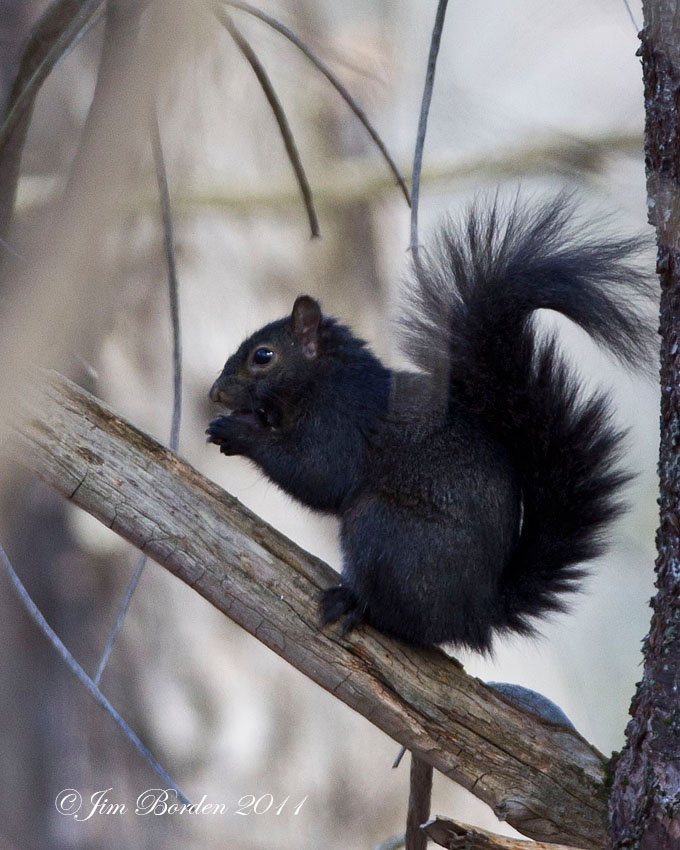
We have always found black squirrels on this part of Gray Hill and we were treated to 4 of them on this afternoon.
Canon 1D Mark IV; Canon 600mm f4; f4.5 1/250 ISO500 about 44 yards
A favorite spot of mine where I can usually find a large group of bachelor bulls only had one bull there and he had dropped his antlers already. He posed for us in many positions in what i considered good, contrasty light.
Canon 1D Mark IV; Canon 600mm f4; f5.6 1/160 ISO500 about 60 yards
The elk were out feeding throughout the day and we found a group of 4 bulls behind one cabin having their afternoon snack. Two of the bulls are developing decent racks and may be trophy bulls in the future. This picture was a good candidate for me to use the better beamer with--sure would next time to help eliminate the shadows.
Canon 7D; Canon 300mm f2.8; f6.3 1/200 ISO640 about 50 yards
Canon 7D; Canon 300mm f2.8; f6.3 1/160 ISO640 about 50 yards
Canon 7D; Canon 300mm f2.8; f6.3 1/250 ISO640 about 50 yards
I have hated the tracking collars that some of the elk are wearing (put on by Pa Game Commission). they are huge, ugly and the yellow marker with numbers can be seen from long distance. I am glad to see that the collar size has decreased and it is now dark brown and sport the new smaller satellite transmitters and antenna. the number has been eliminated-YEAH!!!! This bull with dropped antlers took a few moments to pose with the new style collar for us.

We concluded our day of touring on Saturday by visiting the upper parking area along Dewey Road.
Canon 1D Mark IV; Canon 24-105 f4; f13 1/80 ISO400
At day break Sunday morning we had six bulls in the lawn of the Elk Hideaway. They ate leisurely and sparred before heading off to other areas. Note the shutter speed on this picture-that bull had to lay perfectly still to get this shot with no blur.
Canon 7D; Canon 300mm f2.8; f6.3 1/2.5 ISO1000
The bull later decided that Ginny's bushes looked ready to eat and he meandered over to the bush while the rest of the bulls were sparring.
Canon 1D Mark IV; Canon 300 f2.8; f4 1/200 ISO 1250 about 50 yards
Until next Time
Jim Borden